The "Intelligence Gap" in Modern Media
In 2025, marketing organizations rapidly adopted Large Language Models (LLMs). Teams marveled at their ability to summarize reports and generate copy. But as we enter 2026, a critical limitation has emerged: the "Intelligence Gap." This gap exists between the sophisticated reasoning of an AI and the stale, static data it is often forced to use.
Most AI implementations today are reactive. They rely on "leftovers", data that has been exported, cleaned, and manually uploaded. In the high-velocity world of media operations, this latency is more than an inconvenience; it is a strategic liability.
The High Cost of "Stale Context"
When a Media Auditor or a Head of Marketing asks an AI to "optimize this week's budget allocation," the AI usually looks at a snapshot of the past.
The Latency Trap: By the time a data silo is bridged manually, the market sentiment has shifted, a competitor has outbid you, or a campaign has already hit its frequency cap.
The Manual Grind: Based on industry observations, teams spend approximately 60% of their "AI time" preparing data for the AI, rather than acting on its insights.
The Security Paradox: Frequent manual exports of sensitive spend data create multiple versions of "the truth" and increase the risk of data leaks.
MCP as the "Neural Link" for Data
In our previous discussion of the Model Context Protocol (MCP), we defined it as an open standard that enables AI models to connect to data sources. But the real revolution isn't the connection, it's the Fluidity of Context.
Instead of treating data like a package you send to the AI, MCP treats data like a library the AI can walk through in real-time. This shifts the paradigm from Data Injection to Live Interaction.
1. Contextual Fluidity: Understanding the "Now"
With MCP, an AI agent doesn't just read a file; it understands the environment.
Example 1: Technical Error Detection: If your media spend suddenly spikes due to a technical error in a DSP, an MCP-enabled AI can detect this immediately because it is "plugged in" to the live feed. It doesn't wait for the next CSV upload; it sees the pulse of the operation.
Example 2: Viral Content Response: When an influencer post goes viral and brand search volumes spike by 300%, MCP-enabled AI can immediately detect the trend and automatically shift budget from generic keywords to brand keywords, capturing high-intent traffic while competitors are still reviewing yesterday's dashboards.
Example 3: Competitive Bidding: During a product launch window, when a competitor increases their bid by 40% on your core keywords, real-time MCP access allows your AI to detect the pressure, evaluate inventory levels, and recommend whether to increase bids or shift to alternative, less competitive placements.
2. Model Agnostic, Data Centralized
The beauty of MCP is its neutrality. Whether your organization chooses to use Claude 3.5, GPT-5, or a specialized local LLM for security reasons, the infrastructure remains the same. MCP acts as the universal translator, ensuring that your "Data Soul" remains yours, while the "Reasoning Engine" can be swapped as technology evolves.
3. Security and Governance at Scale
One of the biggest hurdles for Enterprise AI is the "Copy-Paste" risk. MCP allows for what we call a "Zero-Copy" architecture. But what does this actually mean?
Simply put: your data stays in your secured systems, databases, platforms, internal tools and the AI only reads what it needs for a specific query. Nothing is duplicated. Nothing is exported. Nothing leaves your environment. Think of it like giving someone viewing rights to a document instead of making copies.
This is the level of governance required for the 2026 regulatory environment, where data residency and audit trails are non-negotiable.
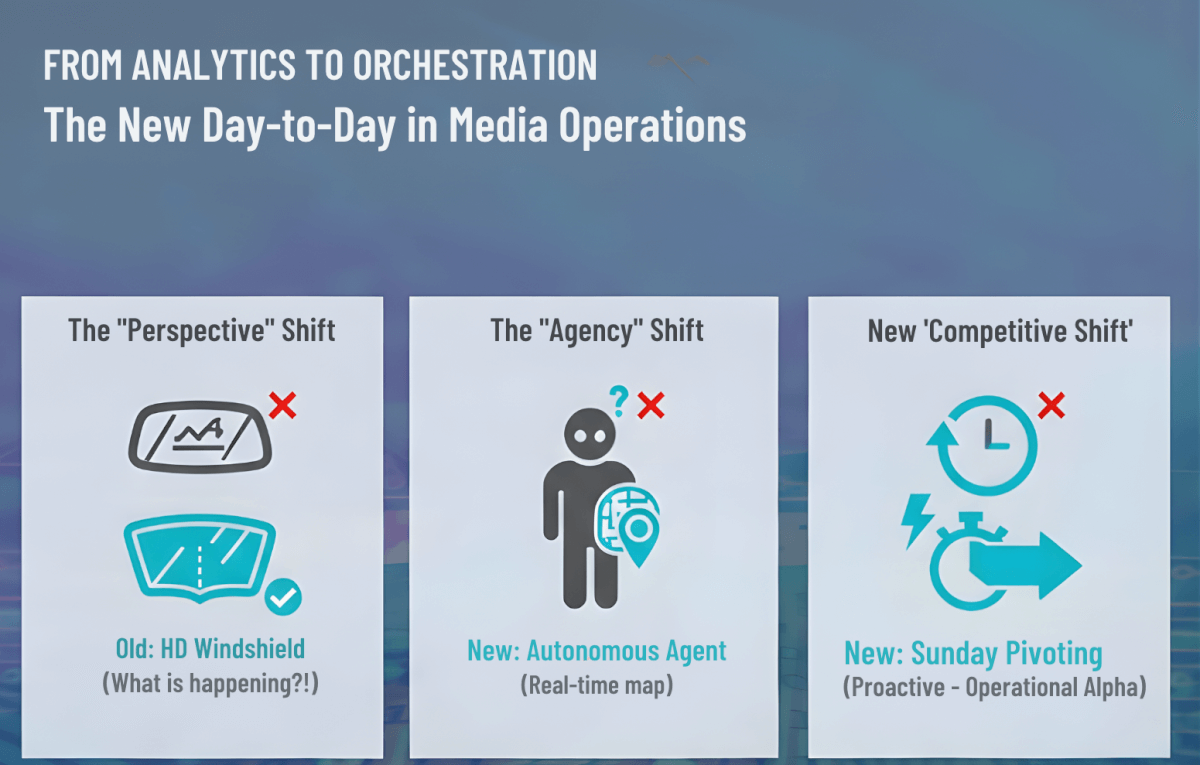
From Analytics to Orchestration
How does this change the day-to-day for Media Operations?
From "What happened?" to "What is happening?": Analytics has traditionally been a rearview mirror. Real-time context through MCP turns it into a high-definition windshield.
The Rise of Autonomous Agents: To have an AI "agent" that can actually execute tasks, it must have a reliable, real-time map of the world. MCP provides that map. Without it, an agent is just a pilot flying blind.
Operational Alpha: The competitive advantage in 2026 will go to the firms that reduce their "time-to-insight" to zero. While competitors are still waiting for their Monday morning dashboards, MCP-driven organizations are already pivoting on Sunday night.
The Infrastructure of Choice
The Model Context Protocol is the first global standard that treats context as a living, breathing part of the AI workflow rather than a static attachment.
As we move forward, the question for leaders is no longer "Which AI should we use?" but "How fast can our data speak to our AI?"