
Mercury Media Technology GmbH & Co. KG
Klostertor 1
20097 Hamburg / Germany
By Torben Seebrandt
10. Dezember 2025
Marketing Effectiveness: How Data-Driven Practices Maximize Media Impact
Marketing departments today are under immense pressure: budgets must be deployed more transparently and efficiently, while teams simultaneously struggle with increasing workloads despite a wide range of automation tools. Yet despite significant effort, real insights often remain scarce — leaving teams without the confidence needed to make decisive choices that lead to meaningful results.
Marketing Effectiveness is becoming a crucial success factor. It has become more important than ever to invest resources wisely and to steer the future development of marketing toward the most promising opportunities — helping organizations strengthen their competitive advantage and establish themselves as industry leaders.
This article shows how maturity assessments, Marketing Mix Modeling (MMM), and Marketing Experiments together set the Marketing Effectiveness engine in motion — and why this is especially relevant for companies in Germany, Austria, Switzerland, Spain and the UK.
Why Marketing Effectiveness Matters More Than Ever
Many marketing teams face the same core problems:
1. Endless possibilities for change
Due to rapid technological evolution, the possibilities for transforming marketing are nearly limitless. Options for designing, structuring and steering both marketing and the broader organization are multiplying. While this accelerates innovation and competition among service and tech providers, it also increases the need for orientation and strategic clarity.
2. Reports generate follow-up questions
There are more KPIs and dashboards than ever — yet deeper examination often raises more questions than answers.
For example:
- What impact does over- or under-delivery of impressions have on business outcomes?
- Why is revenue not increasing despite active campaigns?
- Which non-marketing drivers influence results?
- How did these factors evolve during the last campaign?
These questions cannot be answered using descriptive reporting alone. Some organizations would already be relieved to have a consolidated and up-to-date view of their marketing activities.
3. Correlation instead of causality
Static modeling helps quantify multivariate relationships — but even when models are used, teams frequently confuse correlation with causation.
If revenue rises during a seasonal peak while campaigns run, it remains essential to understand how much of that increase is actually caused by marketing.
4. Reactive instead of proactive management
A lack of reliable insights leads to indecision. Uncertainty and fear of making the “wrong choice” cause teams to cling to existing processes. Opportunities remain unused in an attempt to avoid risk.
Guide to Marketing Effectiveness & Efficiency
Based on these challenges, MMT has developed a structured approach to accelerate Marketing Effectiveness within organizations.
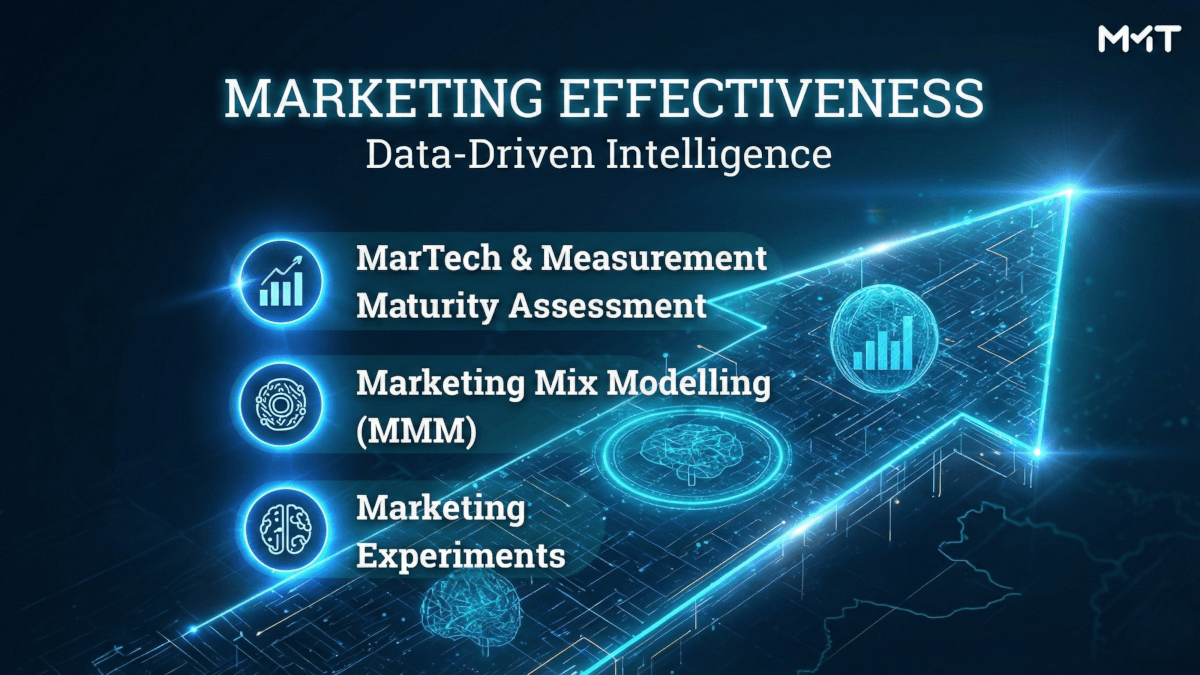
The journey typically begins with a MarTech & Measurement Maturity Assessment, followed by an initial Marketing Mix Modeling (MMM) project to deliver early measurable wins that generate momentum. This foundation enables ongoing MMM work combined with targeted Marketing Experiments — a combination proven to build the trust needed among stakeholders to implement both short-term and long-term strategic initiatives.
Key advantages:
- Clear impulses and actionable recommendations for marketing development
- Reduced effort for low-value tasks such as reporting
- Understanding causal effects instead of simple correlations
- Visibility into influence factors beyond marketing
- Confident, sustainable decisions based on quantified insights
- Improved alignment with C-level stakeholders
- More effective use of current budgets and more efficient deployment of future investments
Maturity Assessment: Understanding Where Companies Truly Stand
Before any investment or optimization, companies must understand their current level of readiness.
A MarTech & Measurement Maturity Assessment uncovers:
- how well data and processes are structured
- which team capabilities are missing or already present
- which quick wins can immediately improve efficiency
- where long-term potential lies
The maturity level determines which levers must be addressed first to ensure effective resource usage over time.
Some companies already have consolidated and up-to-date marketing performance views — others do not.
Some run regular MMMs yet still fail to achieve the expected impact and struggle with complex questions.
Others are overwhelmed by the operational workload required to execute successful campaigns.
The assessment ensures that organizations not only apply MMM effectively but also maintain visibility on medium- and long-term levers.
Marketing Mix Modeling (MMM): The Most Powerful Efficiency Lever
Marketing Mix Modeling answers the core question:
“Which channels and activities actually drive results?”
Why MMM is essential:
- correctly applied, it quantifies causal effects rather than correlations
- identifies inefficient investments
- enables optimized budget allocation
- allows “what-if” simulations
- provides objective, independent insights beyond marketing
MMM shows how marketing truly works — and where each euro delivers the greatest value.
Marketing Experiments: The Instrument of Truth
Even with regular MMMs, questions remain:
- Is this media activity really three times more efficient than others?
- What if we test new channels or formats we’ve never used before?
- How does updated creative affect revenue compared to the previous version?
Marketing Experiments are the gold standard for driving innovation at an economically acceptable level of risk. They validate uncertain MMM insights and uncover new opportunities.
In combination with recurring MMM cycles, experiments ensure efficient marketing investments and make results transparent for stakeholders.
A Roadmap for Sustainable Marketing Effectiveness
Sustainable effectiveness emerges through a clear, repeatable process:
1. Analysis & Diagnosis
Where do we stand? Which data, structures and objectives exist?
2. Actions & Recommendations
Prioritized activities with clear ROI.
3. Technological Enablement
Tools for automation, measurement and collaboration.
4. Continuous Optimization
Regular updates, model refinements and ongoing efficiency gains.
Marketing Effectiveness is not a project — it is an ongoing process.

The Business Impact of Marketing Effectiveness
Companies benefit directly through:
1. Higher media efficiency
Budgets are used where they demonstrably work best.
2. Greater transparency
Influence factors — beyond marketing — become visible, enabling better decisions.
3. C-level-ready communication
Marketing can clearly communicate impact, costs and ROI.
4. More time for strategy
Teams spend less time reacting and more time planning.
Why This Matters Especially for DACH, the UK and Spain
In markets such as Germany, Austria, Switzerland, the UK and Spain, companies face increasing:
- advertising spending
- pressure for efficiency
- regulatory requirements
- expectations for transparency and reporting
Because local market conditions, seasonality and consumer behavior vary significantly, organizations that adopt region-specific approaches achieve markedly higher effectiveness.
Conclusion
Marketing Effectiveness is an essential lever for modern marketing organizations.
Teams that rely on data-driven models, transparent impact analyses and structured strategic guidance achieve:
✔ more efficient budgets
✔ greater transparency
✔ stronger performance
✔ sustainable growth
Ready to increase your marketing effectiveness?
Let’s evaluate together how much potential lies within your marketing setup.

