
Mercury Media Technology GmbH & Co. KG
Klostertor 1
20097 Hamburg / Germany
By Vivian Reifschneider
20. Februar 2026
In the Age of AI Agents, Systems of Record Gain Strategic Importance

Why AI Puts Interchangeable SaaS Under Pressure and Marketing Needs a True Single Source of Truth
The discussion around AI Agents and Large Language Models is often oversimplified. Many hear statements like:
- "AI will replace traditional software."
- "Many SaaS tools will become redundant."
- "Workflows can be controlled directly via prompts."
In fact, AI will put many SaaS products under pressure. But it won't replace everything. What is under pressure is functional, interchangeable SaaS. This refers to software that solves isolated tasks without being deeply anchored in a company's operational core. What is gaining importance, however, are Systems of Record. Especially in marketing.
SaaS is Not the Same as a System of Record
SaaS (Software as a Service) describes a business model: software is provided via the cloud, usually as a subscription. Many SaaS tools solve isolated tasks, e.g.:
- Reporting dashboards
- Social media planners
- BI tools
- Campaign builders
These tools are valuable, but often interchangeable.
A System of Record (SoR) is different: it is the system that stores the authoritative version of the truth.
Examples:
- CRM → System of Record for customer data
- ERP → System of Record for financial data
- Marketing or Media Operations System → SoR for budget, campaign, and performance data
An SoR is not just a tool. It is the Single Source of Truth that teams, Finance, and management rely on.
Why AI Primarily Puts Generic SaaS Under Pressure
AI Agents can today:
- Summarize reports
- Generate campaign structures
- Analyze data
- Cluster target groups
- Automate workflows
Many isolated SaaS functions can be replaced or highly compressed by AI workflows in the future. But AI cannot guarantee an authoritative data basis.
Large Language Models work probabilistically. This means they provide results based on probabilities, not deterministic logic. For budget approvals, ROI calculations, management reporting, or auditability, this is not enough. This is where marketing needs a System of Record.
The Structural Weakness in Marketing
Current studies show that marketing organizations continue to struggle with fragmented data landscapes. According to Salesforce's State of Marketing Report (2024), only 36% of marketing leaders in Germany are fully satisfied with the unification of their data sources. At the same time, companies use an average of nine different data collection methods – a clear sign of structural fragmentation instead of a consistent data basis.
Missing data harmonization remains a central problem in the B2B sector as well. A recent 2025 analysis by Fivetran shows that over 40% of marketers struggle to measure cross-channel ROI because data resides in different systems and is not uniformly integrated. Without a consolidated data basis, performance evaluations and budget decisions become complex and error-prone.
The patterns are clear:
- Data exists, but it is distributed
- KPIs are calculated differently
- Performance figures vary by tool
- Reporting requires manual consolidation
In an AI-driven environment, this problem intensifies. While AI agents increase speed and automation, they do not solve the structural problem of missing data coherence. Without a central Marketing System of Record, marketing remains operationally fragmented and strategically limited.
Why Marketing Needs a System of Record
A true Marketing System of Record creates:
| Benefit | Impact |
|---|---|
| Unified KPI Definition | No conflicting ROAS or CPA figures |
| Real-time Budget Transparency | Clear control over spending |
| Data Governance | Auditability & Compliance |
| Automated Consolidation | Less manual Excel Work |
| Scalability for AI | Reliable basis for AI optimization |
| Historical Comparability | Long-term strategy instead of campaign silos |
The New Architecture: AI at the Edge, SoR at the Core
A solution with a Marketing System of Record could look like this: AI Agents operate at the edge. Systems of Record secure the core.
Let’s be specific and use Media Operations as an example. For media teams, integrating a System of Record means much more than just merging data. In a typical multi-channel environment, campaigns run in parallel on platforms like Social Media, Programmatic, Display, and Paid Search. Each channel produces its own performance data, which is often structured differently. Without a Media SoR, teams must manually consolidate, compare, and prepare this information for reports – a time-consuming process that is prone to errors.
A Media System of Record like Mercury solves this problem by centrally aggregating, validating, and harmonizing data. This gives teams a true Single Source of Truth upon which decisions can be made. Campaign budgets, conversions, and click numbers are traceable at all times, comparable across channels, and historically documented. This transparency allows media teams to react faster, adjust campaigns in real time, and effectively implement AI-supported optimizations.
Furthermore, an SoR allows media planning, execution, and reporting to be linked in a seamless workflow. AI Agents can provide creative suggestions and targeting strategies, while the SoR provides the structured, authoritative basis on which these recommendations are implemented and reviewed. Thus, the combination of AI and a deterministic data basis becomes the decisive lever for efficient, scalable media operations.
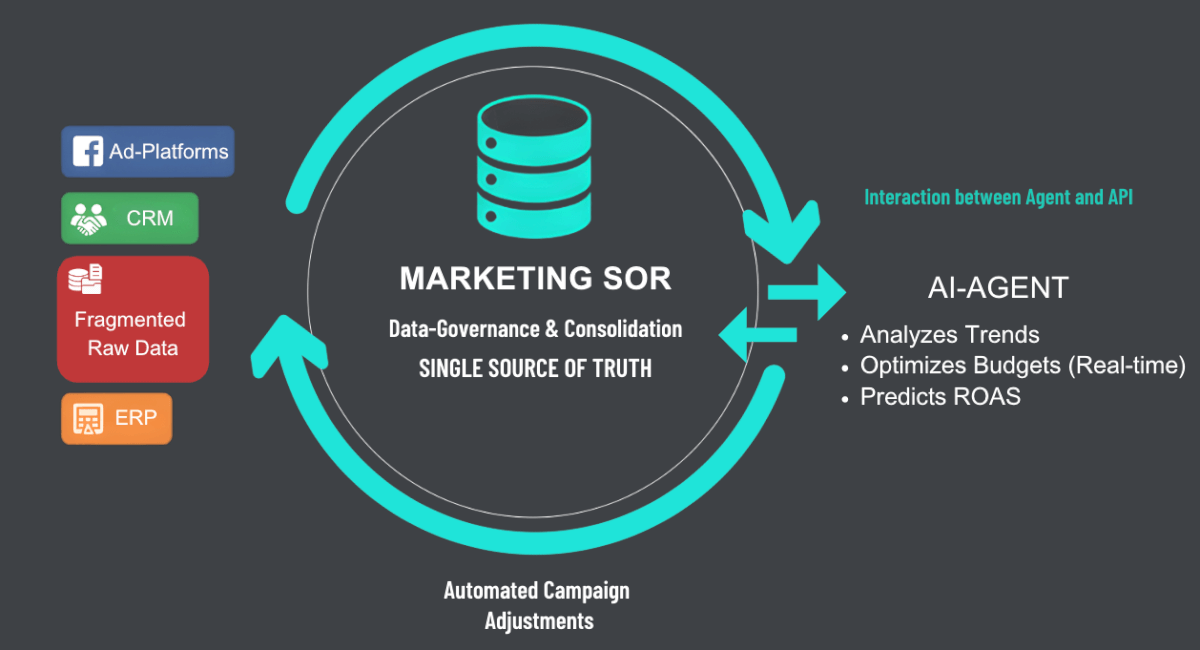
A possible Media Operations workflow where a Marketing System of Record works with an AI Agent could look like this:
- All historical campaign data is structured in the SoR.
- The AI Agent accesses it, identifies optimization potential, and suggests campaign adjustments.
- Campaigns are manually approved in the SoR.
- The AI Agent then automatically starts the campaigns.
- The structured results – leads, conversions, costs, performance – are written back into the SoR.
There they are:
- Consolidated
- Comparable across channels
- Historically stored
- Validated
- Made usable for management decisions
The more AI Agents work, the more important this stable core becomes.
In summary, a Media System of Record, such as Mercury:
- Integrates data from ad platforms, tracking systems, and internal sources
- Connects planning, execution, and reporting
- Creates a unified KPI logic
- Enables cross-channel budget control
- Forms the basis for Marketing Mix Modeling
- Provides a true Single Source of Truth for Media
This makes Mercury more than just another SaaS tool in the stack. It can take on the role of the Media System of Record, which makes the Media Operations Platform particularly relevant in the AI era.
Conclusion: Systems of Record as the Strategic Core of Marketing
In a world where AI Agents automate campaigns, analyze target groups, and provide creative suggestions, an authoritative data basis remains crucial. Systems of Record are not outdated; they are the strategic core that ensures speed, precision, and transparency in marketing. They enable teams to use AI effectively, make decisions based on reliable data, and control campaigns efficiently.
While interchangeable SaaS solutions are increasingly under pressure, Systems of Record like Mercury show how marketing and media remain future-proof: through a central, valid Single Source of Truth that supports AI Agents instead of replacing them. Anyone who truly wants to use AI in marketing needs a strong SoR as a foundation.
The real question is not: "Will AI replace SaaS?" but rather: "Which systems are interchangeable and which are structurally indispensable?"
Interchangeable SaaS is under pressure. Systems of Record are not. On the contrary – they are being promoted.

