
Mercury Media Technology GmbH & Co. KG
Klostertor 1
20097 Hamburg / Germany
By Mercury Media Technology
07. August 2026
The Quiet Shift from All-in-One Platforms to Composable Stacks

The All-in-One Promise Is Losing Its Shine
For years, the pitch from most marketing and media platforms was the same: give us your whole workflow, and we'll handle everything in one place. Fewer logins, one vendor relationship, one throat to choke when something breaks. It was a reasonable trade, for a while.
That trade is looking less appealing to a growing number of teams heading into 2026. The complaint isn't that these platforms don't work. It's that "everything in one place" increasingly means "everything at the pace of one vendor's roadmap," and that pace rarely matches how fast a team's actual needs change.
What "Composable" Actually Means in Practice
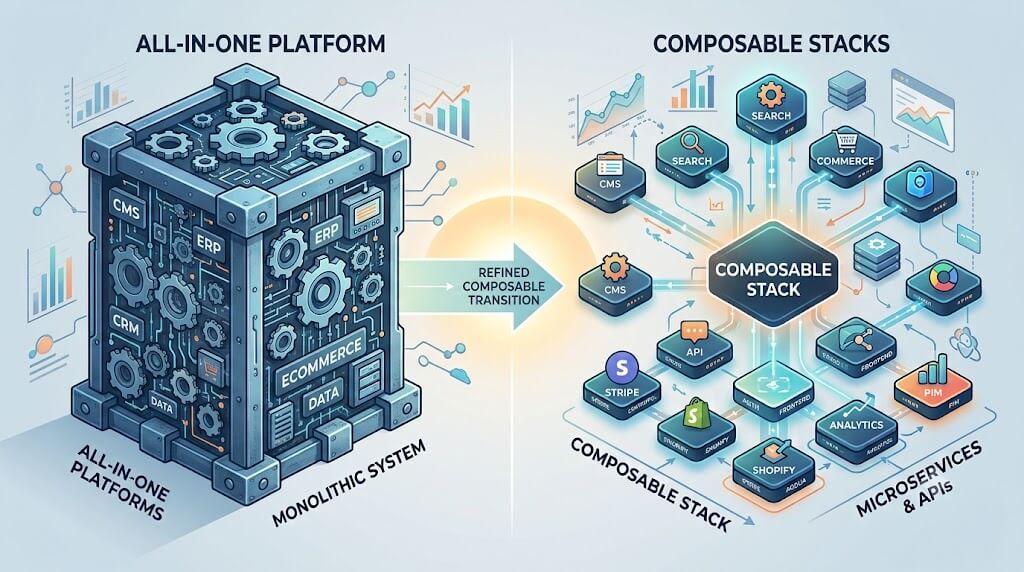
The alternative gaining traction is a composable, API-first approach: instead of one platform trying to do everything adequately, teams assemble a stack from specialized tools that each do one thing well, connected through open interfaces rather than locked inside a single vendor's walls.
This isn't a new idea in software generally, but it's arriving in martech and media operations later than most other categories, partly because switching used to be expensive enough that "good enough and integrated" beat "excellent but separate." That math is shifting as integration itself gets cheaper and faster to build.
Why the Timing Makes Sense Right Now
A few forces are converging at once. Budgets are under more scrutiny, which makes teams less willing to pay for platform features they don't use just to get the one feature they need. AI tooling is evolving fast enough that betting your entire workflow on one vendor's AI roadmap feels riskier than it did two years ago. And the tools for connecting specialized systems, APIs, webhooks, lightweight integration layers, have genuinely gotten easier to work with.
Put together, the argument for "best of breed, connected well" is stronger than it's been in a long time, and weaker arguments for staying monolithic, mostly inertia and switching cost, are eroding.
The Real Tradeoff Nobody Skips Past
None of this is free. A composable stack trades the simplicity of one vendor for the responsibility of making sure the pieces actually talk to each other well. Teams choosing this path are betting that the flexibility is worth owning that integration work themselves, or with a partner who specializes in exactly that connective layer.
That's a real bet, not a free upgrade. The teams doing it successfully tend to be explicit about which parts of their stack are worth being modular, and which parts, usually the ones holding the most foundational data, are worth getting right once rather than swapping out every year.
The Takeaway
The shift away from all-in-one platforms isn't a rejection of consolidation for its own sake. It's a recalculation of where consolidation actually helps versus where it just adds friction. Composable, API-first stacks are winning that recalculation for a growing number of teams, not because monolithic platforms got worse, but because the cost of connecting specialized tools got a lot lower.

