
Mercury Media Technology GmbH & Co. KG
Klostertor 1
20097 Hamburg / Germany
By Mercury Media Technology
23. Juli 2026
Why Media Operations Needs a System of Record — Not Another Tool

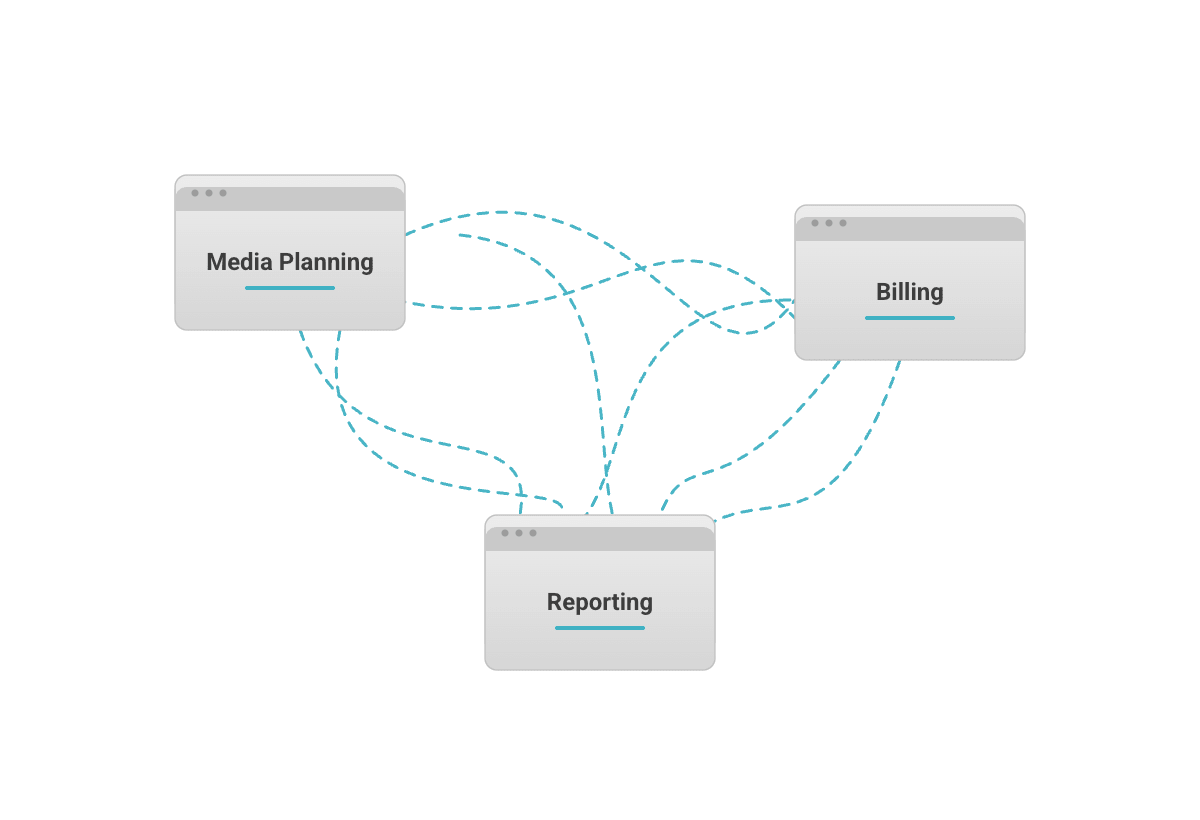
For years, media operations teams have solved fragmentation by adding more tools. A platform for planning, another for reporting, another for creative versioning, another for billing reconciliation. Each one solves a narrow problem well. Together, they create a new one: no single place holds the truth.
Ask five people on a media team where the "real" campaign data lives, and you'll likely get five different answers — a dashboard here, a spreadsheet there, an export from last Tuesday. Not because anyone did anything wrong, but because the industry never built a foundation designed to hold it all together.
The cost of fragmentation
This isn't just an inconvenience. When data lives in silos, every handoff between teams — planning to buying, buying to reporting, reporting to billing — becomes a manual reconciliation task. Errors creep in at every seam. Decisions get made on data that's already a week stale. And when a client asks a straightforward question about performance, the honest answer is often "let us check a few systems and get back to you."
The deeper issue: most platforms in media operations were built to be destinations. They want to own the workflow, the data, and the relationship. That works fine as long as an agency's entire operation fits inside one vendor's walls. It stops working the moment an agency uses more than one system — which is to say, always.
What a System of Record actually means
A System of Record isn't another application competing for attention alongside the rest of the stack. It's the layer underneath — the single, authoritative source that every other tool reads from and writes to. Campaign data, budgets, performance metrics, and operational status live in one place, accessible through open APIs rather than locked inside a proprietary interface.
This matters because it flips the ownership question. Instead of an agency's data belonging to whichever platform happens to hold it, the data belongs to the agency — full stop. Tools become interchangeable. Agencies can adopt new technology, swap out underperforming vendors, or build custom internal workflows without a costly, risky migration each time.
At Mercury, this is the principle we've built around from day one: agency-agnostic by design, API-first by necessity. We don't ask agencies to trust us with their data forever — we ask them to own it, with Mercury as the infrastructure that keeps it organized, accessible, and ready to work with whatever comes next.
Built for what comes next, not just what exists today
The System of Record model also matters because of where the industry is heading. As agencies begin exploring AI-driven tools to support planning, reporting, and analysis, the quality of what those tools can do depends entirely on the quality and accessibility of the underlying data. An AI layer bolted onto a fragmented data landscape inherits all of that fragmentation — inconsistent, incomplete, and hard to trust.
An open, API-first System of Record solves this the same way it solves everything else: by giving agencies a clean, structured foundation that any tool — including AI-driven ones — can build on. Through open interfaces like MCP, agencies aren't locked into a single vendor's AI roadmap; they can connect their own tools, or ours, to the same trusted data layer.
That's a foundation we don't take lightly. Media operations has been Mercury's focus for close to 14 years — long enough to know that automation is only as good as the human expertise verifying it sits behind it, and that no dashboard replaces genuinely understanding how media campaigns actually run.
The takeaway
Media operations doesn't need another tool promising to fix fragmentation from the outside. It needs a foundation that was never fragmented to begin with — one that agencies own, that any tool can plug into, and that's ready for a future none of us can fully predict yet.
That's what a System of Record is for.

